

Real PostgreSQL, MySQL and Valkey.
Connect with ordinary database drivers, and manage instances through the Cloud SQL Admin and Memorystore APIs against the real engines.
Backed by: PostgreSQL, MySQL, Valkey and Redis Real engine
Get startedWhat it covers
CloudBurrow runs real database engines in the cluster. Applications can reach PostgreSQL, MySQL and Valkey with ordinary drivers. The SQL Admin API manages supported operations on those local SQL servers, including the backup and restore path exercised by TestCloudSQLBackups. Each instance the API creates is its own server of the requested version, as TestCloudSQLDatabaseVersions checks. The Memorystore admin APIs create a server of its own per instance and a set of servers per cluster, as exercised by TestMemorystoreCreateConnectUpdateDelete and TestMemorystoreRedisCluster.
- PostgreSQL (
cloudsql), MySQL (cloudsql-mysql) and Valkey for Redis clients (memorystore) - SQL editors read by default, with an explicit Read-write mode
- Cloud SQL Admin instance, database and user operations against real local servers (#1301)
- Tested Cloud SQL connector paths, backups, restore and read replicas
- Instances of PostgreSQL 9.6 to 18 and MySQL 8.0 and 8.4, each a server of that version, with major version upgrades (#1381)
- High availability, point-in-time recovery, cross-region and cascading replicas, external primaries, switchover and MySQL blue-green deployments (#1408, #1614)
- Imports, exports, SSL certificates, server CA rotation and customer-managed keys (#1380, #1538)
- Memorystore create, resize, delete, import and export against local servers (#1302)
- Memorystore for Redis instances (upgrades from 6.x to 7.0 and 7.2, Standard tier failover), Redis Cluster and Valkey instances, with AUTH, in-transit encryption, token auth and IAM auth (#1519, #1549, #1614)
- Redis 3.2, 4.0 and 5.0 instances with in-transit encryption from a TLS front, as Memorystore serves those versions (#1524, #1768)
- ACL policies on Redis Cluster and Valkey instances, with gcloud, Terraform and the console (#1578)
- Verified
gcloud sql,gcloud redisandgcloud memorystorecommands and their Terraform resources
In the console
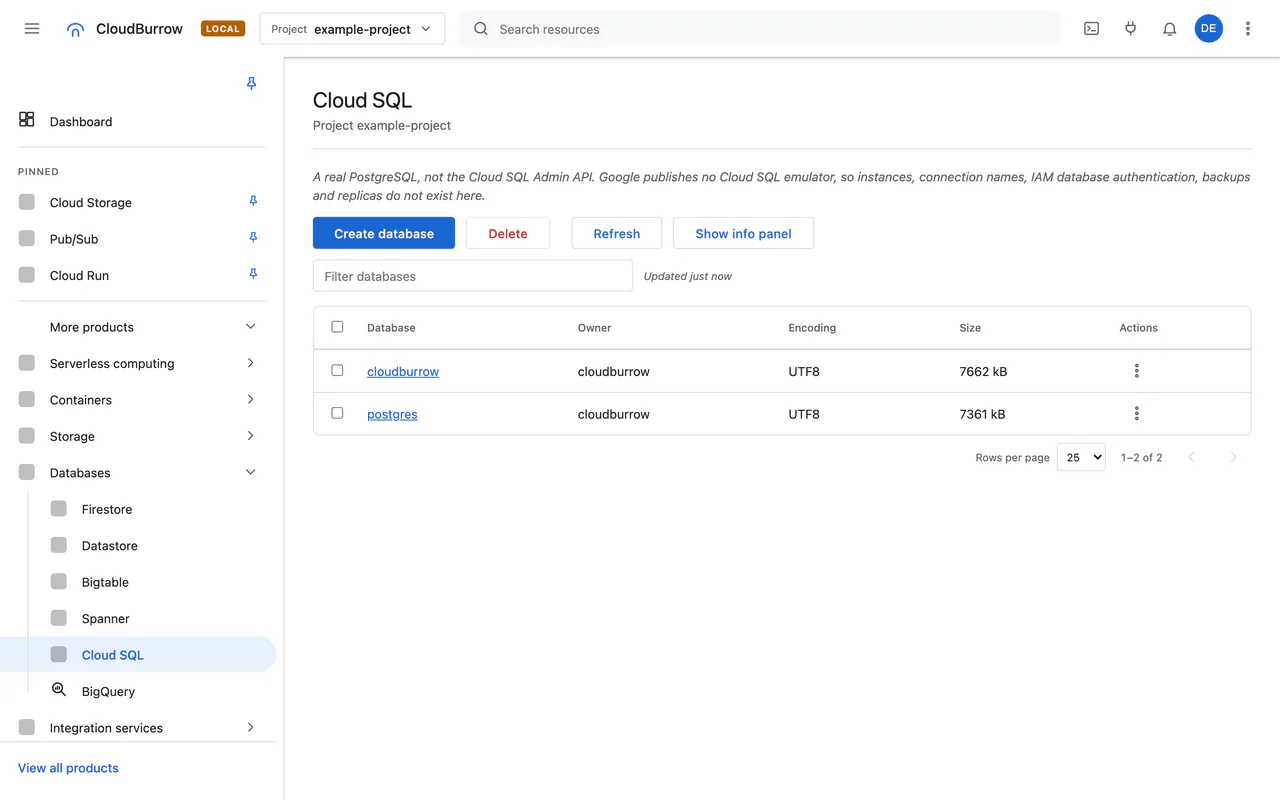
What's verified
Follow the operation matrix to see what the backend serves and the tests linked to Verified calls.
Cloud SQL Admin API (v1)
74 of 80 RPCs Verified in v0.3.0
Memorystore for Redis
69 of 73 RPCs Verified in v0.3.0
Not supported
- 01 / Local boundary
SQL Server, MySQL 5.6 and 5.7, Entra ID certificates, SSRS leases,
rescheduleMaintenanceand IAM database authentication answer 501, with the reason named. - 02 / Local boundary
These are local servers. High availability, backups and encryption are exercised for their API behaviour, not as production protection.
Source: docs/compatibility.md at main 0ea2594.
Questions
Can I create Cloud SQL instances through the API?
Build against Google Cloud APIs, locally
Free and open source under Apache-2.0. No account, no sign-up, no Google Cloud bill.