

Deploy real containers with the Cloud Run API.
Knative-backed services with revisions and scaling, plus jobs, worker pools and instances on Kubernetes workloads.
Backed by: Knative Serving for services; Kubernetes workloads for jobs and workers Knative
Get startedWhat it covers
Cloud Run in CloudBurrow uses an API adapter in front of Knative Serving on the local kind cluster. Deploying a service starts a real container. Service-level scaling is written onto each revision and applied in place, and CloudBurrow’s CPU driver adds instances when the pods’ CPU passes the target. The WorkerPools and Instances clients exercise resources backed by Kubernetes Deployments. The verified source deploy path builds the image locally. Use the coverage table to see which API calls and runtime effects have a named test.
- Create, get, list, update and delete services; inspect their revisions
- Environment variables from Secret Manager
- Min-instances is Verified; max-instances, concurrency, timeout and resource limits are mapped but not load-tested.
- Service-level scaling: automatic with minimum and maximum, or manual instance counts; a scaling change creates no revision (#1790)
- CPU autoscaling on
cpuUtilization, driven by the pods' measured CPU, andconcurrencyUtilization(#1790, #1800) - Disabled services: manual scaling with zero instances answers 503
Service unavailablewhile tag URLs keep serving (#1800, #1802) - Jobs and executions run as Kubernetes batch Jobs (#582)
- Worker pools and standalone instances use Kubernetes Deployments, with worker-pool automatic scaling over REST (#1300, #1788)
- Verified traffic splitting and revision tags using Knative (#1224)
- Supported secret, in-memory, NFS, Cloud SQL and Storage FUSE volumes
- Selected gcloud run commands, source deploys and Terraform resources, including the
scalingblock
In the console
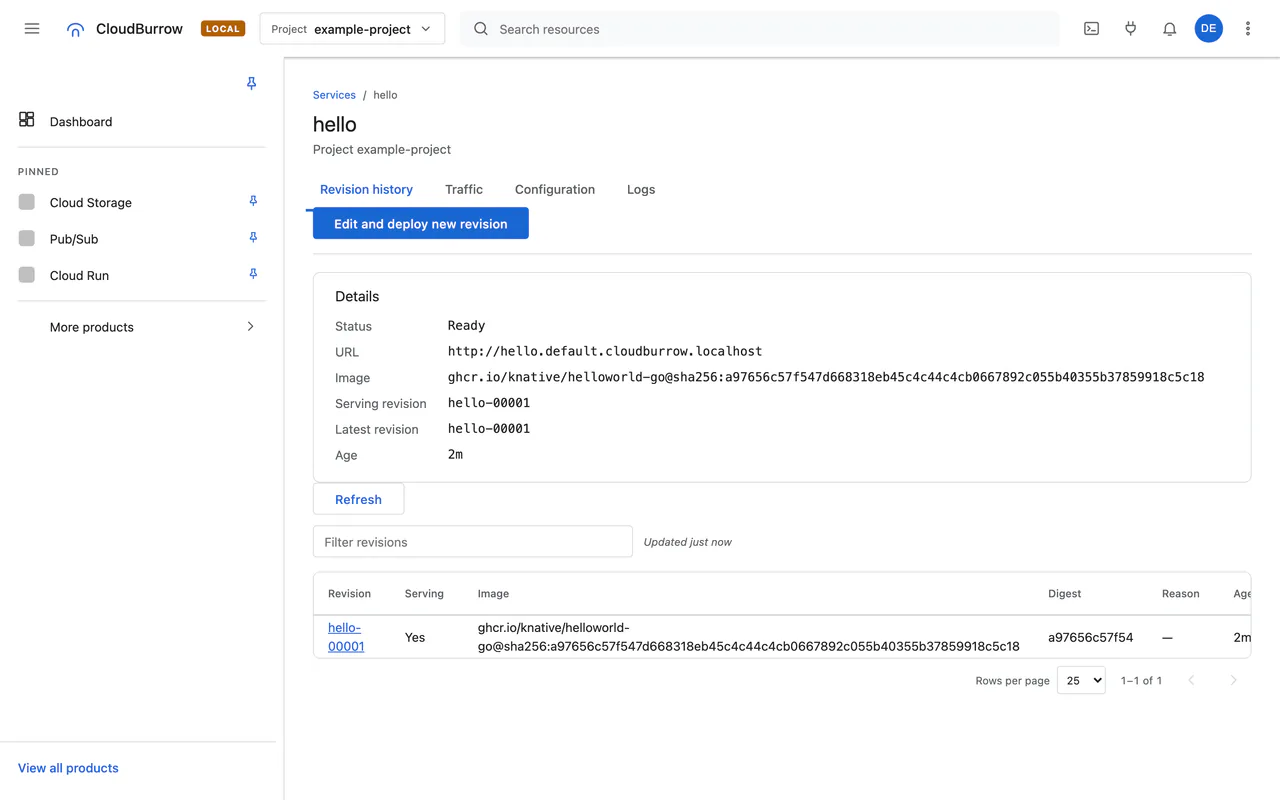
What's verified
Follow the operation matrix to see what the backend serves and the tests linked to Verified calls.
Cloud Run v1 (Knative API)
76 of 76 RPCs Verified in v0.3.0
Not supported
- 01 / Local boundary
VPC access, encryption keys and other documented fields may be stored and returned with no runtime effect. Consult the mapping for each field.
- 02 / Local boundary
Traffic split tests exercise Knative routing. They do not establish Google's production distribution.
- 03 / Local boundary
A disabled service's 503 status code is CloudBurrow's reading: Google's page names no status code.
Source: docs/compatibility.md at main 0ea2594.
Questions
What does the Cloud Run adapter map?
Can I run Cloud Run Jobs?
Does service-level scaling work?
Build against Google Cloud APIs, locally
Free and open source under Apache-2.0. No account, no sign-up, no Google Cloud bill.